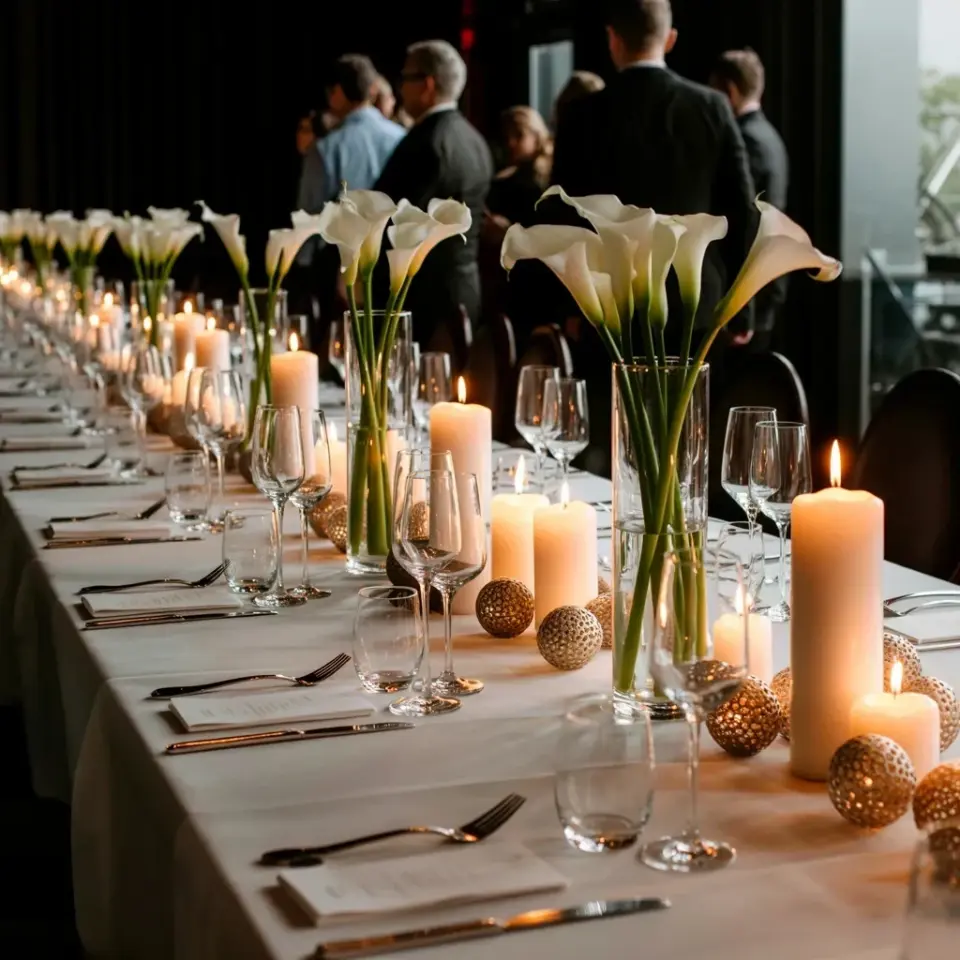
You rearranged the flowers three times before anyone arrived. You fluffed the stems, adjusted the vase, and then watched your aunt try to hold a conversation around a wall of pink peonies. A beautiful tablescape should bring people together, not separate them. And that’s exactly what happens when the centerpiece is taller than the wine glasses. Honestly, I’ve been the guest who spent the whole dinner staring at a fern instead of the person I was talking to. It’s not a great look for anyone.
This isn’t about hating tall flowers. It’s about understanding that a table setting is a meeting place, not a stage for a botanical showstopper. When you can’t see past the foliage, you start shouting. People lean sideways. They tilt their chairs. Somebody eventually says, “Wait, what?” and the whole conversation falls apart. So let’s talk about how to keep your tablescape gorgeous without turning dinner into a game of hide and seek.
Why a Tall Centerpiece Destroys the Dinner Party Mood
Think about the last dinner party that felt genuinely comfortable. You could see everyone’s faces. The food didn’t have to be passed blindly around a giant arrangement. The candles, if any, flickered at eye level. That’s the kind of evening that makes people linger.
Here’s the thing: a tall centerpiece acts like a wall. It blocks sight lines, muffles energy, and makes guests feel like they’re in separate booths at a weird restaurant. Not gonna lie, I’ve been to a wedding where the centerpiece was so massive that the couple had to text each other during dinner to communicate. That was absurd. We laughed about it, but it also meant nobody at our table actually talked.
The fix is simple in theory. Keep anything on the table below eye level. No one should have to bob and weave to see the person across from them. If you’re hosting a dinner party, your job is to make conversation easy. The decoration should help, not hinder.
Low and Slow: The Art of the Compact Tablescape
A low tablescape is just as stylish as a tall one, and it works twice as hard for your dinner party. Think of artfully arranged platters, small bowls of olives, and a single low vase with a few sprigs of eucalyptus. You get all the texture and color without the obstruction.
One of my favorite tricks is to use a wooden board as the anchor. Lay it down the center of the table, then cluster mismatched condiment jars, tiny vases, and a couple of small pumpkins or lemons on top. It feels intentional, not cluttered. And there’s a bonus: guests can reach over it easily, so passing bread doesn’t require a fork lift.
If you’re worried about empty space, don’t be. Negative space on a table helps people feel calm. It also gives them room to rest their elbows and actually use the conversation area. A cramped table makes everyone hunch. A low, airy arrangement invites everyone to relax.
Bud Vases Are the Unsung Heroes of Table Decor
Bud vases are the workhorses nobody talks about. They’re small, yes, but they do the heavy lifting in a tablescape without blocking anyone’s face. I have a collection of tiny glass bottles and old medicine vials that I fill with a single bloom or a few strands of thyme. It looks like I hired a florist, but it cost me about four dollars.
The best part about bud vases is their flexibility. You can scatter them down a long table, cluster three together in the middle, or put one at each place setting as a dinner party favor. Your guests can literally talk over them. That’s the dream.
And here’s a practical tip: use herbs instead of flowers. Rosemary, mint, and thyme smell incredible and look surprisingly elegant in a small vase. They don’t need water every five minutes, and they won’t droop into someone’s appetizer. Honestly, I’ve replaced my florist visits with a quick trip to the grocery store herb aisle. No one has noticed the difference, except my wallet.
The Eye Contact Rule for Tablescapes and Seating
If you’re hosting a dinner party, you want eye contact. That’s the whole point of the gathering. So I follow the twelve-inch rule: anything taller than twelve inches on the table gets a serious review. Otherwise, it goes somewhere else, like the sideboard or the kitchen counter.
Why twelve inches? It’s roughly the height of a standard drinking glass. If your centerpiece pokes above that, it’s probably going to interfere. Unless your guests are giraffes, but I’m assuming they’re not.
This rule also applies to candles. A couple of short candles in glass holders are perfect. A giant candelabra might look dramatic, but it’ll bounce light right into your guests’ eyes. They’ll squint, then think the table decor is somehow their fault. Don’t do that to them.
How to Style a Low Centerpiece That Still Feels Special
You don’t need a towering arrangement to make a statement. Start with a shallow bowl or a cake stand. Add a few whole fruits, some seasonal leaves, and a handful of votives. That’s the kind of tablescape that photographs beautifully and lets everyone actually enjoy the meal.
Another approach is to use a long, narrow tray as your base. Fill it with small ceramic mushrooms, pinecones, or even pretty seashells, depending on the season. This creates a visual pathway down the table without any height. It’s like a miniature landscape that your guests can admire up close.
If you’re craving a little drama, go wide instead of high. Lay a trailing vine or a garland down the middle. Put a small vase at each end. Your table will feel abundant and curated, but nobody will have to play peekaboo with the person across the table. And yes, you can still call it a centerpiece, even if it’s only four inches tall.
When You Really Want Height: A Tall Centerpiece That Actually Works
Okay, so you love tall arrangements. I get it. There are ways to include them without ruining the dinner party. Position the tall centerpiece at one end of the table, not in the middle. This works especially well for a rectangular table with seating arranged mostly on the two long sides. The people at that end can enjoy it, and everyone else stays in the clear.
Another trick is to hang greenery from the ceiling, like a suspended installation. That gives you the vertical drama without landing on the table. If that sounds like too much work, use a narrow, see-through vase with just a few branches. Transparency matters. A glass vase filled with water and a couple of curly willow branches offers height but still lets people glimpse each other through the stems.
Just remember: a centerpiece should be a conversation starter, not a conversation stopper. If your guests have to plan their seating around the flowers, you’ve gone too far. You can always move the tall arrangement to the buffet table after the main course. That way you get the wow factor at the start, and then it steps aside for the real magic: actual human connection.
One last thing before you go. If you’ve ever been stuck behind a monstrous centerpiece at a dinner party, you know how annoying it is. Don’t be that host. Keep your tablescape low, keep your sight lines clear, and let the conversation flow. Your guests will thank you, even if they never say it. And next time you’re at a friend’s house and they’re about to fluff a giant peony arrangement, just send them this article. Maybe they’ll get the message.
This post was researched and drafted with AI assistance, then personally reviewed and edited by Fern before publishing.
Leave a Comment